
Liberty County FTA Routes Differ by Court
Missing court does not play out the same way in every Liberty County courtroom. One court may issue a warrant. Another may just note the absence. The County Court at Law and the Criminal Court warn that a skipped hearing or daily docket can end in a warrant, municipal courts post their own citation and payment rules, and a JP citation belongs to the precinct printed on its face. Only the court itself knows whether the case now carries an FTA, an arrest warrant, a capias pro fine, or a bare missed date. So call before you pay or show up. Ask what step fits your case.
Liberty County Bench Warrants Explained
A bench warrant is court process tied to a missed appearance or an unmet court obligation. It can grow out of a citation, a docket setting, a payment order, or a bond condition. The wording matters. A municipal portal may show nothing more than a citation flag, while a Liberty County criminal docket can carry a separate arrest warrant entry. For justice and municipal cases, Texas Chapter 45A sets the notice, appearance, hardship, good-faith, and recall rules that govern how these matters move. Those rules do not promise that online payment fixes every case, and missed dates do not all follow one script. The official Chapter 45A text controls the state procedure.
Missed Dates Follow Local Steps
Liberty County's municipal courts show why the stage matters. Liberty treats a missed promise to appear as its own FTA, with a $300 window fine that excludes collection fees, warrant consequences, and one reset without judge approval if you handle it in person by 5 p.m. Dayton sends a Last Warrant Notice before any later arrest warrant and posts a similar FTA warning. Those are city notices, not a countywide rule. A JP court or the County Court at Law may follow a different notice and hearing path. Ask for the exact setting date, whether the judge has issued a warrant, and which office can reset it.
How Liberty County Bench Warrants Are Issued
For a municipal or JP failure to appear, Chapter 45A gives the court a process with notice and a chance to appear or resolve the case under its conditions. The judge or magistrate decides whether to issue process. A sworn complaint or the court record supports the warrant, and the sheriff, a constable, a city officer, or another authorized peace officer may serve it. County misdemeanor and district cases work differently. Use the court named in the docket. Liberty County's Criminal Court posts a daily docket and warns that a missed appearance can result in an arrest warrant, and the County Court at Law page carries its own route and docket details. The Liberty County County Court at Law page gives the court's instructions.
A posted Liberty County court warning is not a status check for your case. Call the clerk to learn what the docket shows today.
Liberty County JP Warrants Stay Precinct Based
Each justice court in Liberty County handles its own traffic and Class C matters, so a JP warrant stays with its precinct. JP1 sits at the Liberty Annex, JP3 on Highway 146 North, JP4 at the Dayton Annex, and JP5 in Cleveland. JP6 appears in the county directory. The county posts no dedicated JP2 page. Go by the precinct printed on the citation, not the office nearest your home or the city where you live, and check the official JP4 page before contacting that court.
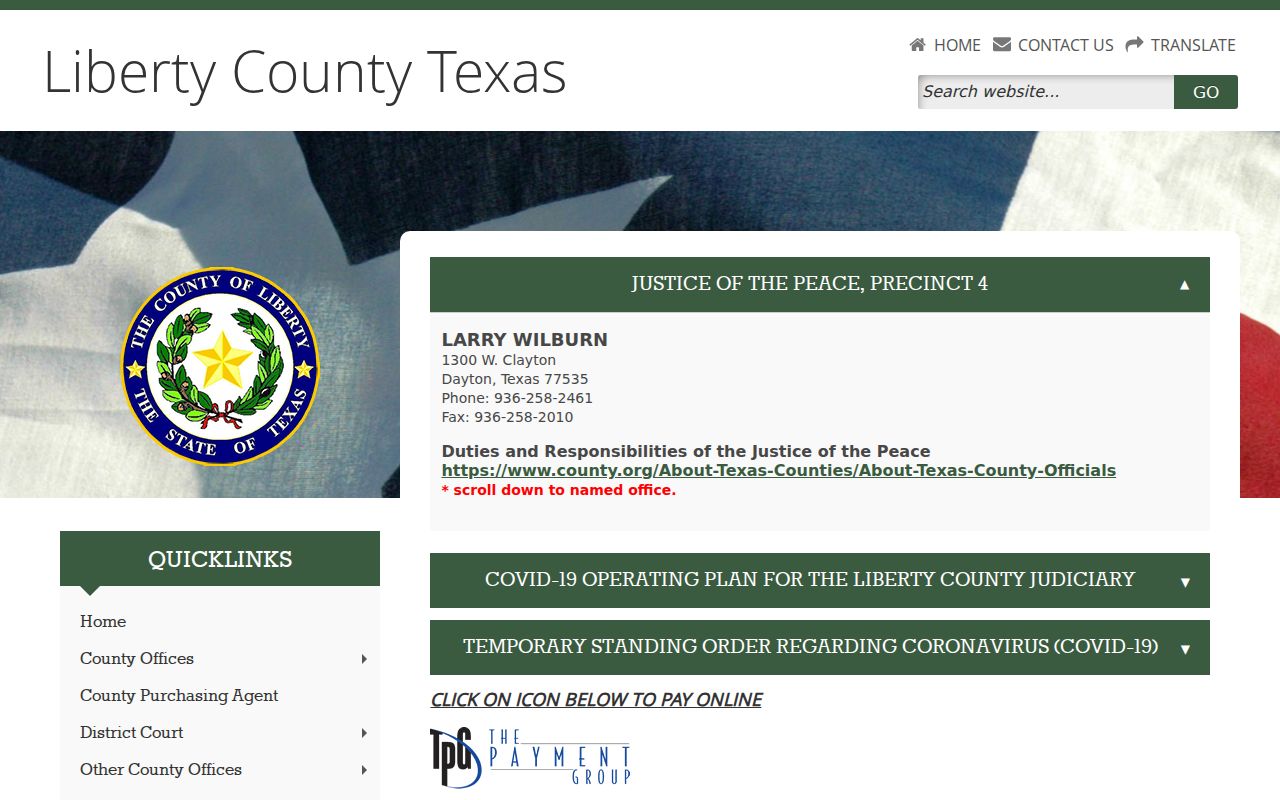
The annex also houses other Liberty County services, so confirm the JP counter and its current public-access instructions. The JP1 page lists plea, driving-safety, fine, and community-service forms; a traffic warrant question goes to that court, not a county roster. View JP1's official forms and contact page.
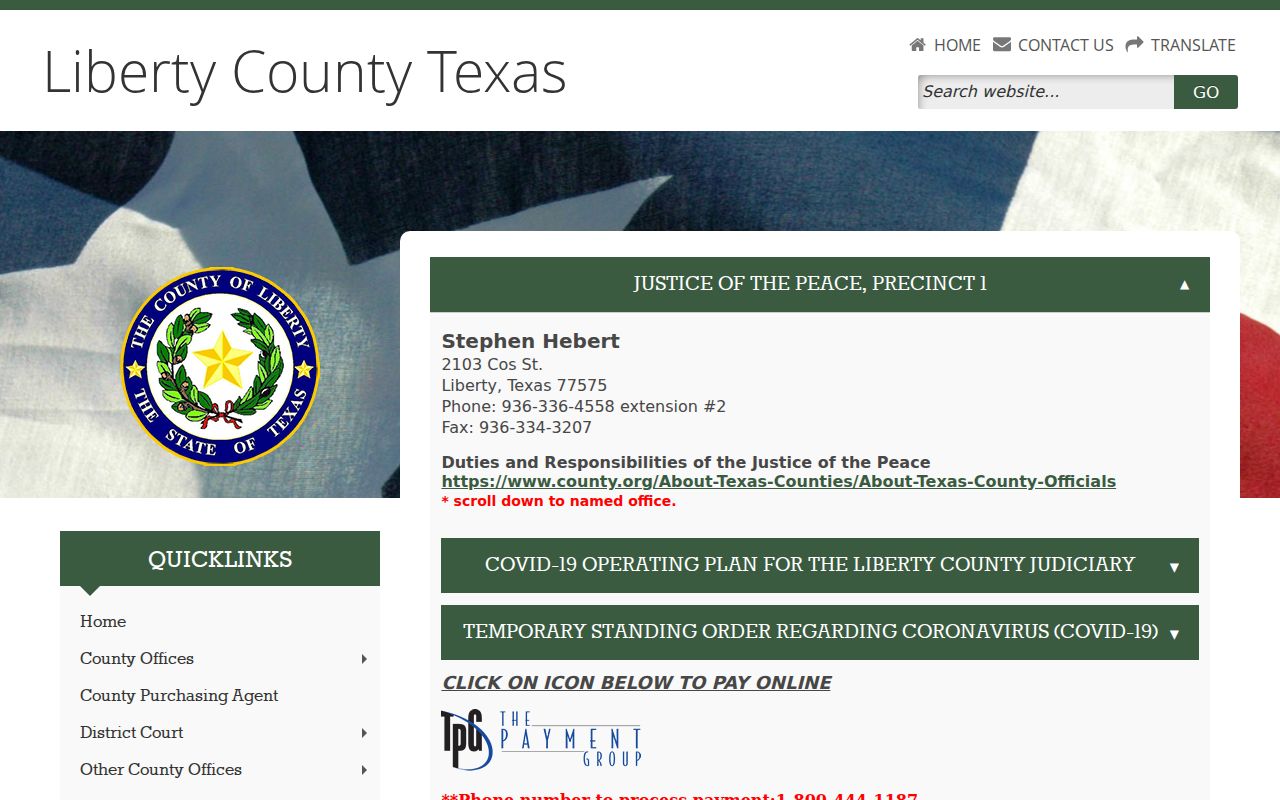
JP forms list the Liberty County court's options. Ask the judge or clerk whether one fits your case. For the next precinct over, check the official JP3 contact and payment page for current service details.
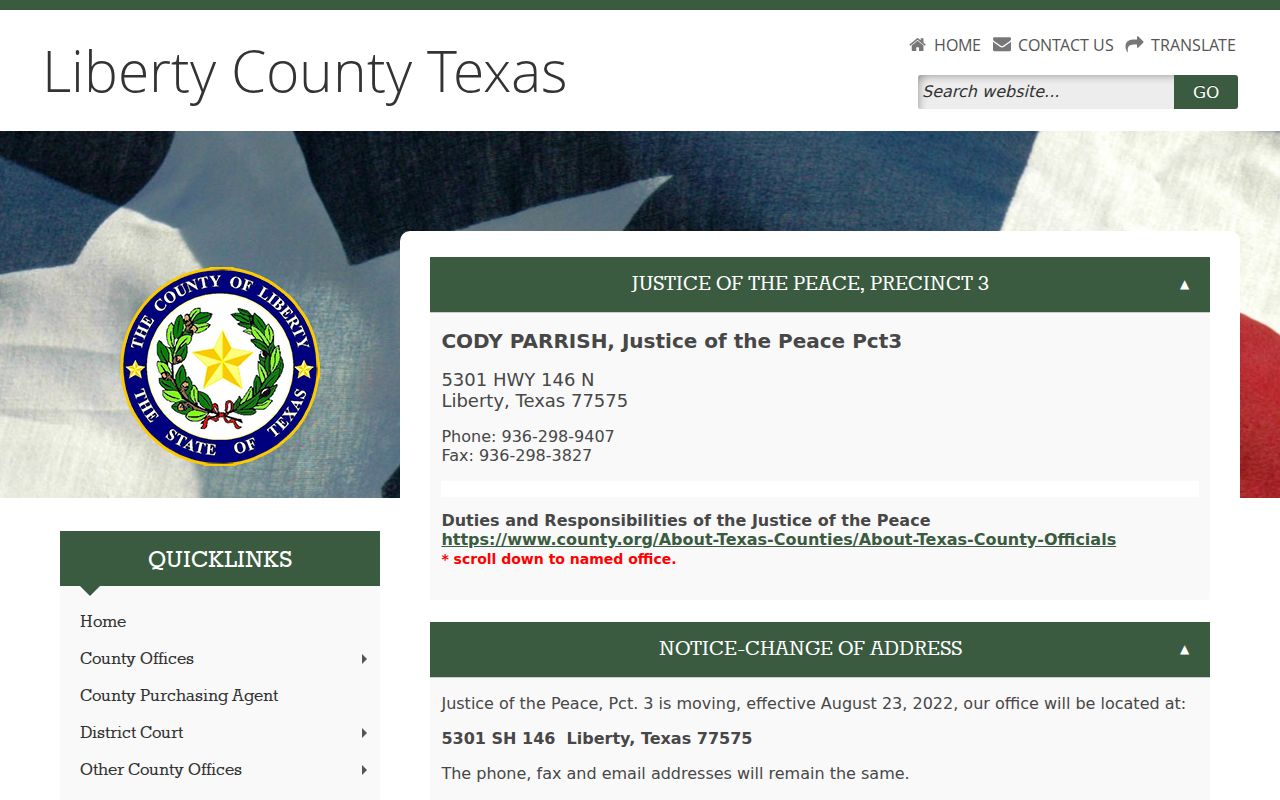
Use the precinct printed on your Liberty County citation, and confirm any payment or reset with its clerk.
Bench Warrants and Arrest Warrants Compared
The file and the reason for the process tell a bench warrant from an arrest warrant. A capias pro fine has its own Texas meaning. Rely on the label in the order, or ask the Liberty County issuing clerk to explain it.
| Process | Common local trigger | First office |
|---|---|---|
| Bench or FTA warrant | Missed court date or required step | Court that set the appearance |
| Arrest warrant | Magistrate order based on a sworn complaint and probable cause | Issuing court and serving agency |
| Capias pro fine | Unpaid judgment after statutory hearing and resolution opportunity | Issuing JP or municipal court |
| License hold | Eligible FTA/FTP report to DPS | Court that reported the matter |
A DPS renewal consequence is not itself proof that an arrest warrant exists.
Capias Pro Fine Needs Court Review
A capias orders that a person be brought before a court. In Texas, a capias pro fine follows a failure to satisfy a judgment after the required process. Chapter 45A demands an undue-hardship hearing before this process can issue for nonpayment, and it allows recall once a person gives notice for a hearing or voluntarily appears with a good-faith effort. Liberty County courts apply that same framework.
- FTA
- A failure to appear as required by a court or citation.
- Recall
- The issuing court withdraws the warrant.
- Quash
- A judge sets aside process; the underlying case may remain open.
Ask the JP or municipal court which hearing or payment applies. A web vendor cannot recall a Liberty County court order.
Resolving a Liberty County Bench Warrant
Pick up the phone before you walk into a courthouse or jail. In Liberty County, call the court that issued the bench warrant, or have counsel do it. Ask what that court allows: a new date, a voluntary appearance, full payment, a payment plan, community service, an ability-to-pay hearing, or an appearance by your lawyer. Liberty Municipal Court tells people to speak with the clerk first. Dayton, meanwhile, wants anyone seeking community service to appear before the judge.
Confirm the route first. A voluntary appearance does not mean every county arrest warrant can be handled at a municipal court counter or without booking.
- Identify the court and get the case or citation number.
- Ask whether a warrant was issued and what action can recall it.
- Confirm the amount, method, appearance place, and judge-review requirement.
- Request a receipt or written recall confirmation, then ask when other systems will update.
For the county warrant check, call the Sheriff at 936-336-4507. The office also takes fax, mail, email, and in-person requests. It holds no warrant money and offers no no-arrest bond, and its FAQ notes that booking and a magistrate appearance come first, then bond.
Liberty County Reset Options Belong to Each Court
Each Liberty County court writes its own reset rules. Liberty Municipal Court grants one reset without judge approval, but only if you handle the request in person by 5 p.m. Dayton posts its own notice, payment methods, payment plan, community-service request, and a collection fee that kicks in after more than 60 days. JP5 lists payment-plan and community-service forms. Other courts may differ. So never carry one court's reset or payment rule to a different case. Ask the court directly whether the judge must review your request and whether it will issue a new date or a recall order. JP5's own material shows its forms and options vary by precinct. The official JP5 contact page gives access details, not a warrant listing.
Use the Liberty County clerk's current form, and ask the court to confirm eligibility and the final status.
Finding the Court That Issued the Warrant
Start with the paperwork. Your notice, citation, cause number, or docket should name the court that issued the warrant. County Court at Law misdemeanor cases run through the County Clerk and the court manager, while the 75th and 253rd District Courts use the District Clerk and their coordinators. Municipal citations belong to the city court. JP traffic matters follow the printed precinct. Where you live does not set venue, so a Dayton resident with a JP4 ticket contacts JP4, and a Cleveland municipal citation goes to Cleveland Municipal Court. If no court is named, give the Sheriff's Warrants Division the details it requests and ask which agency or clerk can confirm the file. The directory at Liberty County's official contact page lists coordinator and clerk routes.
Proof of Recall Needs Follow Up
Save everything. A payment receipt, reset notice, judge's order, bond receipt, or clerk message each proves a different step in resolving a Liberty County warrant. Ask whether the court changed the case status, recalled the warrant, and notified the Sheriff or DPS where required. No countywide delay for removing a recalled record is published, so check with the issuing court first, then the Sheriff's Warrants Division if it held an entry. A public-information request can ask for existing status records, though it may be redacted or referred.